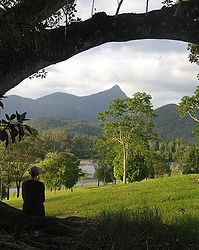
Insight
Meditation
In seeing -
What utter joy!
The small mind becomes
transparent, empty,
without foundation.
Christopher
Last Updated:

An Awakened Life

Extract from An Awakened Life by Christopher Titmuss

COMPASSION AND LIBERATION

There can be a real and immediate liberation. An enlightened life sees through the fiction of self and the mythology surrounding it. We know freedom's presence in our daily life and abide aware of the circumstances of others.

Someone I have known for several years came to see me at home. He told me he was fully liberated. He had participated in a number of retreats, workshops, and engaged in intensive meditation. Some weeks previously he had an experience of going beyond mind and body, and ever since, he had felt liberated and enlightened. This liberation was still with him and he felt he was living in the present moment all the time. When I asked him how he was living his life since this event, he laughed and said he was spending time with friends, watching videos into the early hours, and feeling light, free, and happy. Hanging out watching videos every night seems superficial to the extreme, I told him. How long will it be before you become bored with such a daily life? I asked him. He shrugged, and left. I never saw him again.

A day or two later, another friend, a woman dedicated to serving others, came to see me. She had made numerous personal sacrifices to sustain her work with victims of child abuse. She had also participated in several retreats for inner renewal. I noticed she had a great deal of personal calm and a warm love for others. She said, "I serve others and work hard on myself. Instead of taking holidays, I attend retreats. But I'm not liberated. I'm not an enlightened human being. I haven't had such an experience”. 

I reflected on these two conversations. Both people were talking about themselves in opposite ways. One felt he was enlightened. There is nothing more to do, nothing more to be gained, and no need to make any further effort. The other felt she was a long way from enlightenment, yet clearly and directly manifested love, concern, and conviction. To whom does our heart respond despite their different descriptions of themselves? 

There can be a real and immediate liberation. An enlightened life sees through the fiction of self and the mythology surrounding it. We know freedom's presence in our daily life and abide aware of the circumstances of others. It is a misunderstanding to think that liberation is a short-lived experience followed by an easy way of living. Some claim such enlightenment, but our perception of them makes us feel uncomfortable. It is appropriate to assume that the quality of a liberated person's life will communicate something different from the run of the mill circumstances. Not surprisingly, we tend to doubt the understanding of claimants of enlightenment who show an attitude of indifference.

Some people freely and generously express love, but don't describe themselves as liberated. It may mean such people have more work to do on themselves. Perhaps they need a teacher and teachings that point to immediate liberation. On the other hand, perhaps they cling to a picture of what an enlightenment experience is. We must be honest with ourselves and each other when making important statements about who we are. We can deceive ourselves either way. 
Is it too much to ask the human spirit to be liberated and engaged in dedicated service to others? It is not surprising that some teachings seem to neglect the fate of the world. Genuine liberation impacts on the heart bring something deep out of us. Throughout the year, I listen in and out of retreats to people's accounts of their deepest experiences. People say they are liberated yet an unquenchable love fails to manifest out of that liberation. Others say, "I am not liberated," and yet show a tremendous capacity to love. 

Perhaps how we think about ourselves doesn't matter so much. One person's thought says: “I am liberated”. Another person's thought says, “I am not liberated”. If we can just see the true emptiness of all thoughts about the self, and not cling to any of them, perhaps true liberation is immediately available. Enlightenment still takes place in this world for women and men. It takes place in retreats and monasteries and outside of them. The here and now still provides the most wonderful opportunity of all. 

The enlightenment of humanity goes on. Through such awakening, we pay the greatest respect to the ordinary and everyday. 

MADE IN OUR IMAGE

What omniscient God would give powers to human beings to inflict so much suffering on each other, as well as other sentient beings? 

There is a child inside of us: a child who wants to surrender to an archetypal figure and who wants a system that will make life easier. We want to be neatly protected from everything so that we don't have to live with our eyes open. There are plenty of religious messages that appeal to the child inside, but genuine inquiry appeals to the adult within us.

To imagine that everything is in the hands of a super-mundane mythological figure called God cuts the mind off from living in the real world. For if this is true, then the belief is true for all and God must take total responsibility for all obscene and barbaric behaviour that runs through human existence. This God is not worthy of worship, not worthy of submission to, but only fit for condemnation. We do not have to seek God's forgiveness for what human beings have inflicted on each other. We need the capacity to forgive God for the pain and sorrow He has permitted to be inflicted on this Earth. If we keep praying to God and He doesn't answer our prayers, then perhaps we need to look elsewhere for the answer.

One group of spiritual seekers took a slightly more pragmatic view. They claimed there is a God who made us in His image. God kept some powers for Himself and gave some power to human beings. What would be considered good and beautiful belonged to God, while human beings produced all the suffering that arose on the Earth. This group's God also finds Himself left in the most unacceptable condition. What omniscient God would give powers to human beings to inflict so much suffering on each other, as well as other sentient beings? 

According to this group's view, God created the Earth, made a laboratory out of it, and watched a tragic experiment of suffering unfold beyond imagination. To non-believers, this God seems powerless to stop His experiment. It would seem an enormous error of judgement on the part of this God to grant independent powers to human beings knowing their capacity to abuse such powers in the most unimaginably cruel ways. To believe in this God as all-powerful means that we would need to preserve a Hell for one Person, and that Person would be God. We do not need to love this God but to pity Him for a crazy initiative that sadly got out of hand.
There are some groups on the Earth who claim this God sent down his Son (s) to share in the suffering of others, to know their pain. Others claim that he sent prophets and saints down to Earth. To even question this as a true reality can bring the wrath of believers firmly down upon us. In Dharma teachings, this belief is regarded as a metaphor, an interpretation of events. In Dharma, we interpret the metaphor as meaning that out of realisation of the Immeasurable emerges the compassionate heart.

When we adopt narrow beliefs, we end up unquestioningly believing in the personality of a deeply compassionate being and take less and less notice of they actually said. We disregard their teachings of love, non-harming and voluntary simplicity. Instead, we raise their status to a super-natural level to avoid applying their teachings to our daily life. We can believe in our God, seek the intervention of his Son, prophets or gurus and simultaneously live a life bearing little relationship to the teachings. We want to get as much as we can out of this world for ourselves, family and country and believe we will go straight into eternal happiness in the next. 

Our beliefs easily govern and determine our relationships with people. If we hold onto religious beliefs, we become intolerant of people who hold different beliefs to our own. If we hold onto secular beliefs, we become intolerant of people who hold onto religious beliefs. Yet, both groups of people have more in common than what separates them. Due to our interpretation of our experience and what we have heard, we draw conclusions. Our view may inhibit an open relationship with others if we look at them through the distortion of our beliefs. 

When you elevate a religious belief onto a pedestal, you lose touch with the reality of another person. You have found something to believe in, so you believe others need the same thing to believe in as well. No wonder others maintain a cynical attitude towards religion. Teachings and practices point to a middle ground neither caught up in extreme beliefs such as believing in an all-powerful God nor that everything rests in the hands of humanity. Nothing is that simple. Claims over true reality remain as claims. No more, no less. We can carry on blindly holding onto our beliefs, or examine them to see them for what they are. Beliefs take second place to wisdom. 

THE DANCE OF SIVA

We see that what is happening at our sense doors is simply a series of momentary activities, and momentary impressions. What we make of these momentary impressions shapes our happiness and unhappiness.

Indian spirituality has always had a love of the ascetic and austere. The saints and sages have examined the world of pleasure, dismissed the importance of impressions upon the senses, and put out the uncompromising message of renunciation. However, to the Western mind, stories of naked fakirs and sadhus sound bizarre and unworldly but it would be a pity to dismiss Indian spirituality out of hand. We should not overlook the sadhus' view of pleasure and profit seekers, whom they regard as equally bizarre and unworldly, since death makes a mockery of all pursuit of privilege and pleasure.
The story of Siva in India reminds us in tough terms of the life of renunciation. There are many depictions of Siva, the auspicious one. Siva is one of the aspects of existence, representing the whole dance of life, the totality of activity and expression. Pictures of Siva have captured a deep insight. Siva is virtually naked with long matted hair, and around him is a cobra. The way sadhus make matted hair in India involves putting wet cow dung on their hair and then covering it with ashes to dry it out. Despite the danger of the cobra, the repulsiveness of the wet cow dung on the body, having no clothing and being an ascetic, Siva is dancing. 

Such a story might repulse us. We might not able to relate to it in any way. It seems to confirm all our views about Indian spirituality. We are hardly going to go out looking for the dung of Jersey cows to mat our hair. Nevertheless, it would be a pity to dismiss the story of Siva so quickly as many do, including millions of religious Indians who find such a lifestyle all a bit strange. We forget the message; Siva is dancing. Siva is always dancing. It is the dance of triumph, of joy, of celebration – despite the cobra, the stink of cow dung in his hair and the cold wind on his naked body. Siva is one with the dance of existence. The whole play of life goes on. How many of us dance daily, even with all the comforts we have surrounded ourselves with?

We see that what is happening at our sense doors is simply a series of momentary activities, and momentary impressions. What we make of these momentary impressions shapes our happiness and unhappiness. When we come down to the actuality, there is a bare touch on the eye in the form of a colour or shape, a bare touch on the ear in the form of sound and so on. Present to the eye, present to the mind. These momentary impressions have become very important to us, they make up our world, and it's the only world we know. We can easily find that our time is devoted to having certain types of impressions on our senses and avoiding other impressions.

We can gain some understanding about ourselves from watching the forces of attraction and aversion around these impressions. If we don't we are liable to get caught up in unhealthy patterns – always wanting things to go our way and hating it when they don't. Sometimes it is hard to admit how much we depend on experiencing pleasant impressions reacting over unpleasant ones.

Perhaps we have had this experience of really wanting something. We did everything possible to make it often. We succeeded and we got a thrill out of it. Perhaps we got a succession of thrills, but eventually, the thrill fades. There is no longer excitement, no longer the big buzz that we remember. In retrospect, we often see that years spent in the pursuit of personal pleasure can feel like wasted time. There are more important things in life than that.
If we can really get a sense of what it means to live fully amidst the sweet and stinking aromas of life, we can become one with Siva, one with the whole dance of existence.

A PROFOUND OPENING 

We have had a taste of freedom, but then it's gone and we are left with the memory. We don't feel that depth of freedom any more, so naturally enough, we would like to repeat the experience. 

We believe that there's something obstructing unconditional freedom, and when we come down to it we are convinced that states of mind have an inherent power to stop it. We speak of hindrances, obstacles, problems, other people, and situations. We've granted all these extraordinary powers over our consciousness. We're convinced that people and circumstances block our freedom. We live in this mythology, and we can't imagine it being otherwise. If something is troubling our mind, we have the view that we must get rid of it or overcome it, and that once we finish with it, we'll be free. This is a terrible paradox. Can we hear ourselves saying that the condition for unconditioned freedom is changing the conditions? 

Can our state of mind really block freedom? There may be some moments when there's a personal story going on in our mind. We seem caught up in it, and would rather not have to go through such an experience. Whatever the unsatisfactory experience, we know it as a state of mind that arises and passes away. If the state of mind had the power to stay without change, then we would really have a problem, but this is obviously not the case.

All this effort seems to reinforce the view that clouds truly have the capacity to stop the sun from shining. But what side of the sun are we looking from? This is the extraordinary misunderstanding that we find ourselves believing in. We sometimes experience a touch of freedom that manifests extraordinarily clearly. At that moment, we sense we have finally arrived, and there is nothing more to do. We cannot add to this experience in any way. The walls of our mind and the definitions of our existence have dropped away. There is an immeasurable freedom that stands incomparable. We know that we cannot possibly add to such an experience. 

Then this liberating experience fades due to the influence of conditions upon our consciousness. We have tasted something, but it has slipped into memory. The familiar mind is back, reborn into the present moment. We have had a taste of freedom, but then it's gone and we are left with the memory. We don't feel that depth of freedom any more, so naturally enough, we would like to repeat the experience. Should that be our priority?

A profound opening can have an extraordinary impact on our perceptions and priorities. There are two ways to acknowledge these deep experiences. One recognises the experience for itself with appreciation. There is no need to look any further, and it may not have any obvious bearing on your life. The second pays attention to any insights within the field of such an experience, and the consequences of such insights. The insights and understanding matter more than the quality of the experience, itself. 

I doubt if any human being can continuously retain that extraordinary experience of centreless freedom in every moment. I certainly have never met such a person. The mind moves in mindful and less than mindful ways. That does not deny this immeasurable freedom at the core of being, but it also makes allowances for our humanity. The everyday mind has a place in the scheme of things, though it never has to stretch far from a centreless freedom that lies at the root of all things. The apple never falls far from the tree. In this centreless freedom, there is no suffering, no dissatisfaction whatsoever. 

There is a common misconception that if we were egoless, that profound moment wouldn't fade and would always stay with us. We would live our lives thoroughly clear and knowledgeable about every thing and every issue. There would be insight into every area of interest. But it would be foolish to imagine that immeasurable freedom offers omniscience. This is an idealised version of liberation – not enjoyed by the Buddha or any teacher since. Out of the great depth of a liberating experience comes a knowing of freedom in daily life. If it doesn't, then the memory of the experience will be all that is left. Why? Because something wasn't realised, something wasn't seen. There wasn't a knowing that came out of the experience. This knowing grounded in awareness makes clear that freedom lies at the root of being.

We can easily assume that the teachings point to an absolute clarity about everything in every moment of existence. That would give us extraordinary power. We would be able to predict with absolute certainty the consequences of our actions. We would know everything that goes on in the past, present and future. There is no evidence on earth that any human being has ever reached that. Again, we keep confusing knowing liberation with omniscience in all directions.

Predictions about the future from prophets and religious texts abound. There are more astrologers in the East and West than priests. We want to believe that certain people can look accurately down the tunnel of time, perceive all the conditions available, and accurately state what will happen in the future. They might be right and they might equally be hopelessly wrong in their predications. 

We remember in Palestine the prophet who predicted the coming of the Messiah. The daughter of the tyrant ruler persuaded her father to have the prophet's head cut off and brought to her on a plate during a party at the palace. When religious people and astrologers make predictions about the future, they too lose their head.

Yet, a timeless knowing is liberating and unstoppable. This knowing never concerns itself with the changing face of past, present and future. What is it that one knows? We know freedom. We can know an awakened life, and know its presence in our existence. We know the value of living a noble way of life. We know the emptiness of the ego, and the emptiness of views about cause and effect. We know the emptiness of craving, clinging and possessiveness. We know the end of suffering over this and that. 

We know happiness and deep contentment. We know there is nowhere to go, nothing to be gotten, and nothing worth becoming caught up in. We know the importance of treating others as we wish to be treated, and we know the power of friendship. We know the end of belief in birth and death. We know the Deathless, we know Nirvana. There is nothing more we need to know.


Validated: HTML, CSS | development »
admin »